Welcome to Jordan’s carved stone,
desert silence & starry skies
What to Expect
Jordan builds slowly, through a landscape that shifts colour as the light changes, through a hospitality that is not performance but inheritance, and through ancient sites that deserve their place among the world's greatest wonders.

Best time to visitMarch–May and September–October are the sweet spots: warm days, cool evenings, and the desert light at its best. Come in winter for near-empty ancient sites, or summer if you don't mind serious heat.

Say it like a local‘Marhaba’ (hello) and ‘Shukran’ (thank you) go a long way in a country where hospitality is cultural. And when plans shift, which they often will, you'll hear ‘yalla’: let's go, come on, hurry up, all at once.

On the menuZarb, meat and vegetables slow-cooked for hours in a pit of buried coals, is the dish worth planning a desert evening around. But save room for knafeh, a warm, cheese-filled pastry soaked in syrup and topped with pistachios.

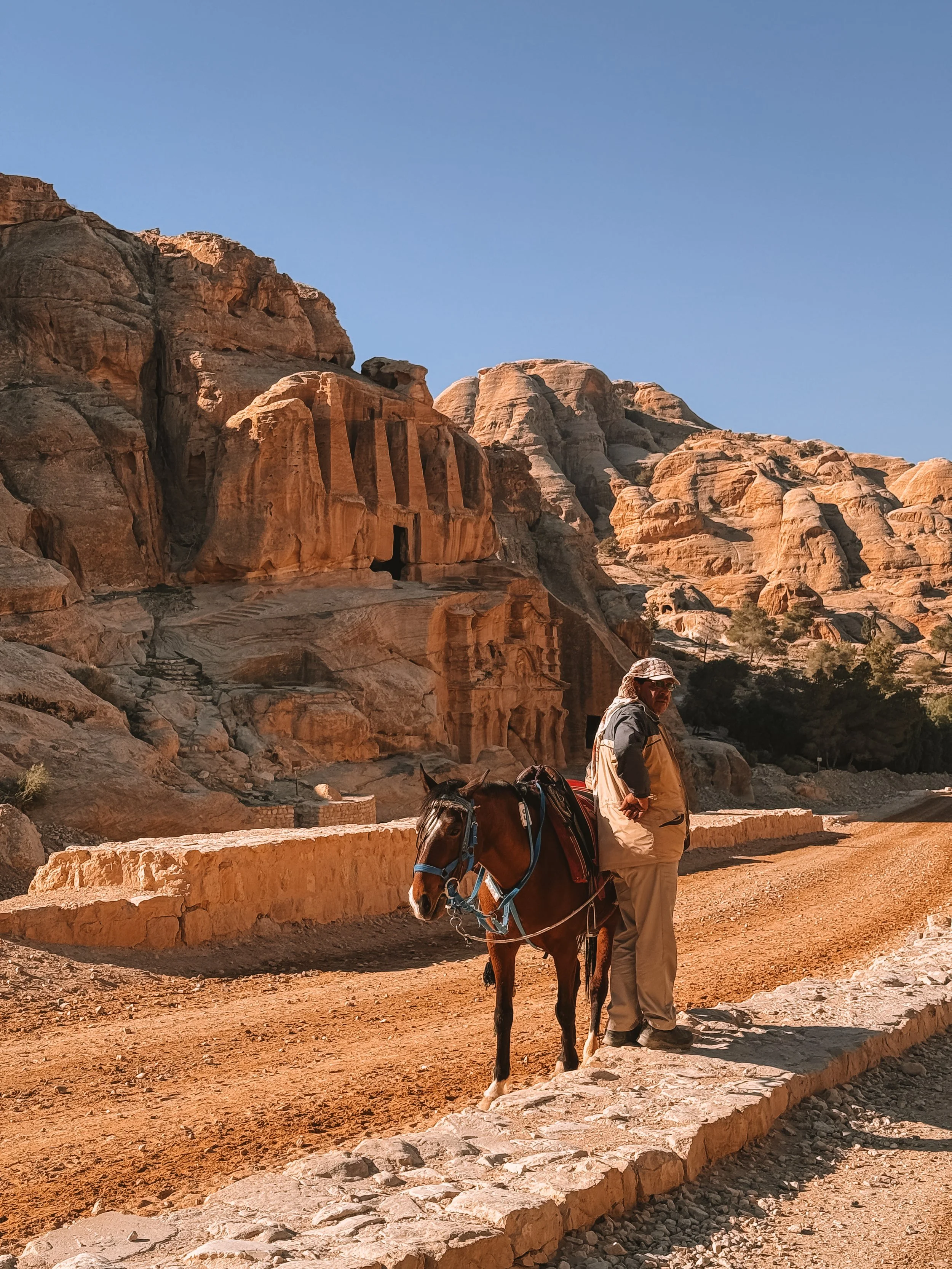
Under the radarBeyond Petra and Wadi Rum, Jordan holds quieter chapters: Byzantine mosaics in Madaba, Roman ruins at Jerash, canyon hikes through Dana Nature Reserve. Petra alone has trails deep into the surrounding mountains where you'll walk for hours and see no one.
Cruising through Jordan
A seven-day route through the south of Jordan, where the country makes its strongest case: the coral reefs of Aqaba, the red desert of Wadi Rum, two full days in Petra, the mineral waters of the Dead Sea, and a final morning in Amman.
Details
Built around a rental car and roughly 700km of driving, this itinerary is paced for full days without rushing them: one destination at a time, with the logistics (checkpoints, 4x4 pickups into Wadi Rum, Jordan Pass strategy) worked out in advance so you're not solving them on the road. It includes the Al-Khubtha Trail's free aerial view over the Treasury that most visitors never find, the back-door route to the Monastery, and a straight answer on whether Petra by Night is worth the tired legs.
Our favourite experiences
from Jordan
-
Jordan's 27km of Red Sea coastline punches well above its size. The Cedar Pride, a cargo ship deliberately sunk in 1985, has had four decades to become part of the reef, soft coral now draping what were once its cargo holds, and there's an air pocket inside the hull where you can surface, remove your regulator, and breathe. Pair it with the Gorgonian reef, where sea fans over a metre wide cling to a sloping coral wall thick with nudibranchs and moray eels. Two dives, one morning, more marine life than most destinations offer in a week.
-
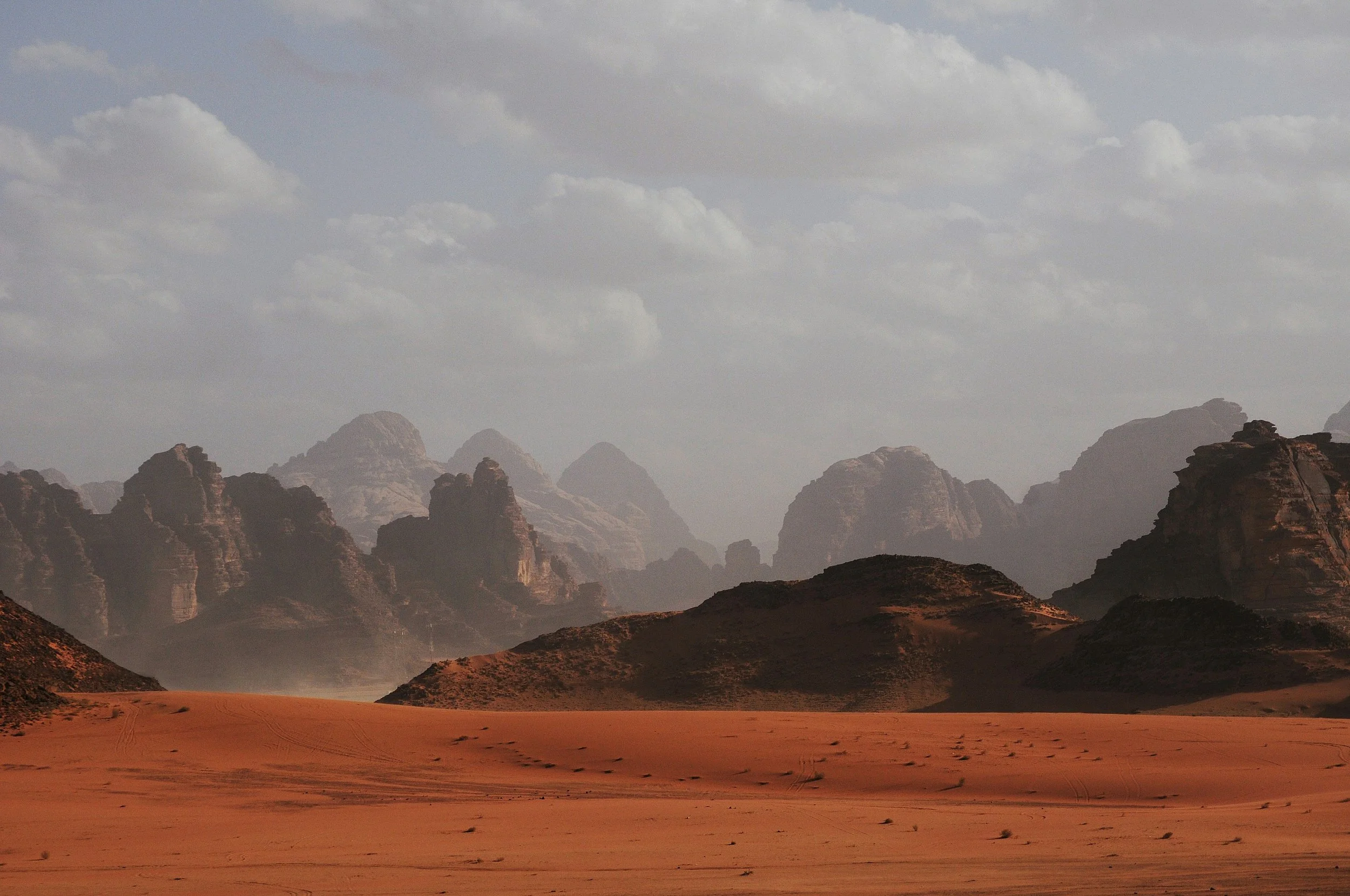
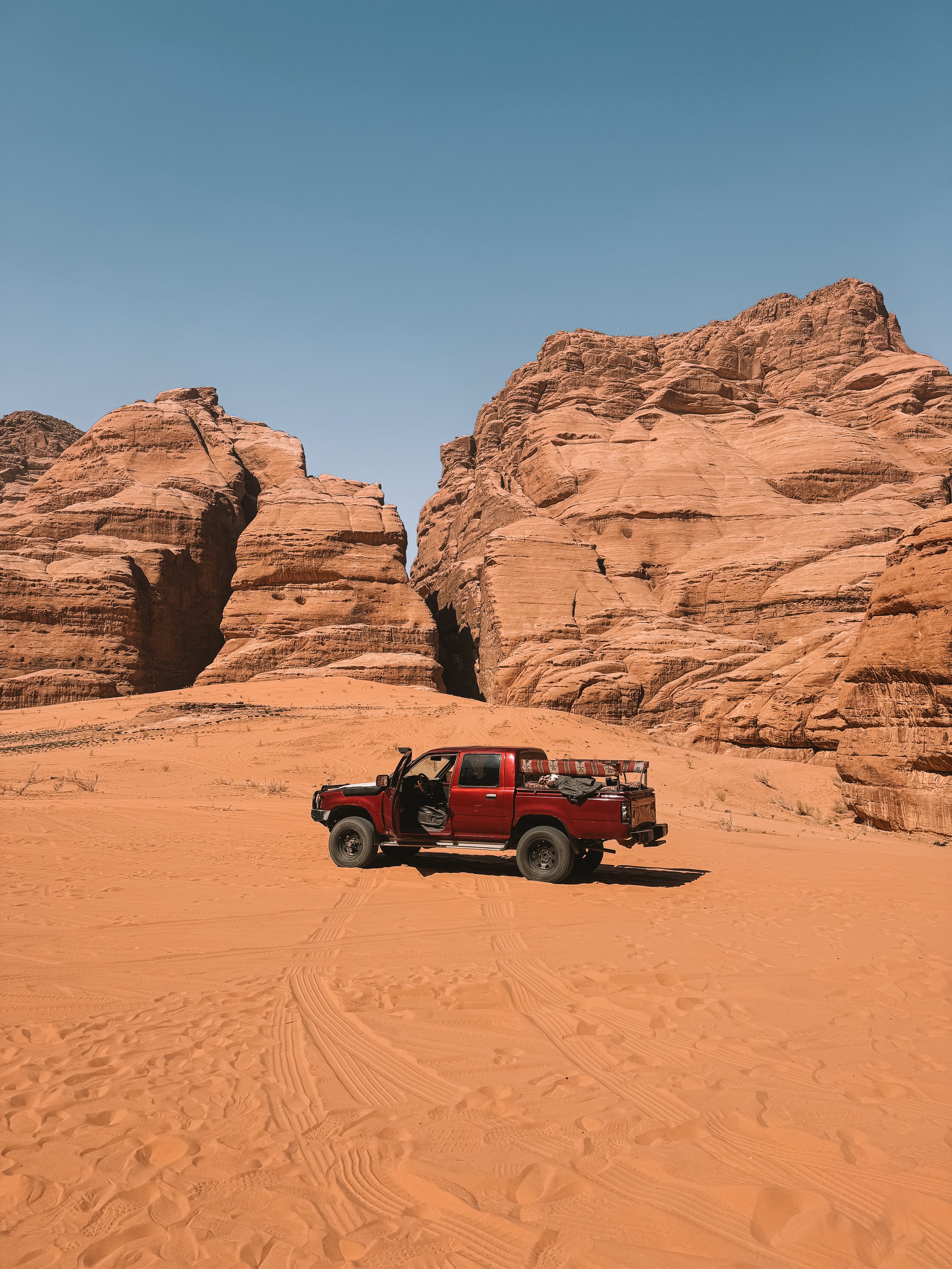
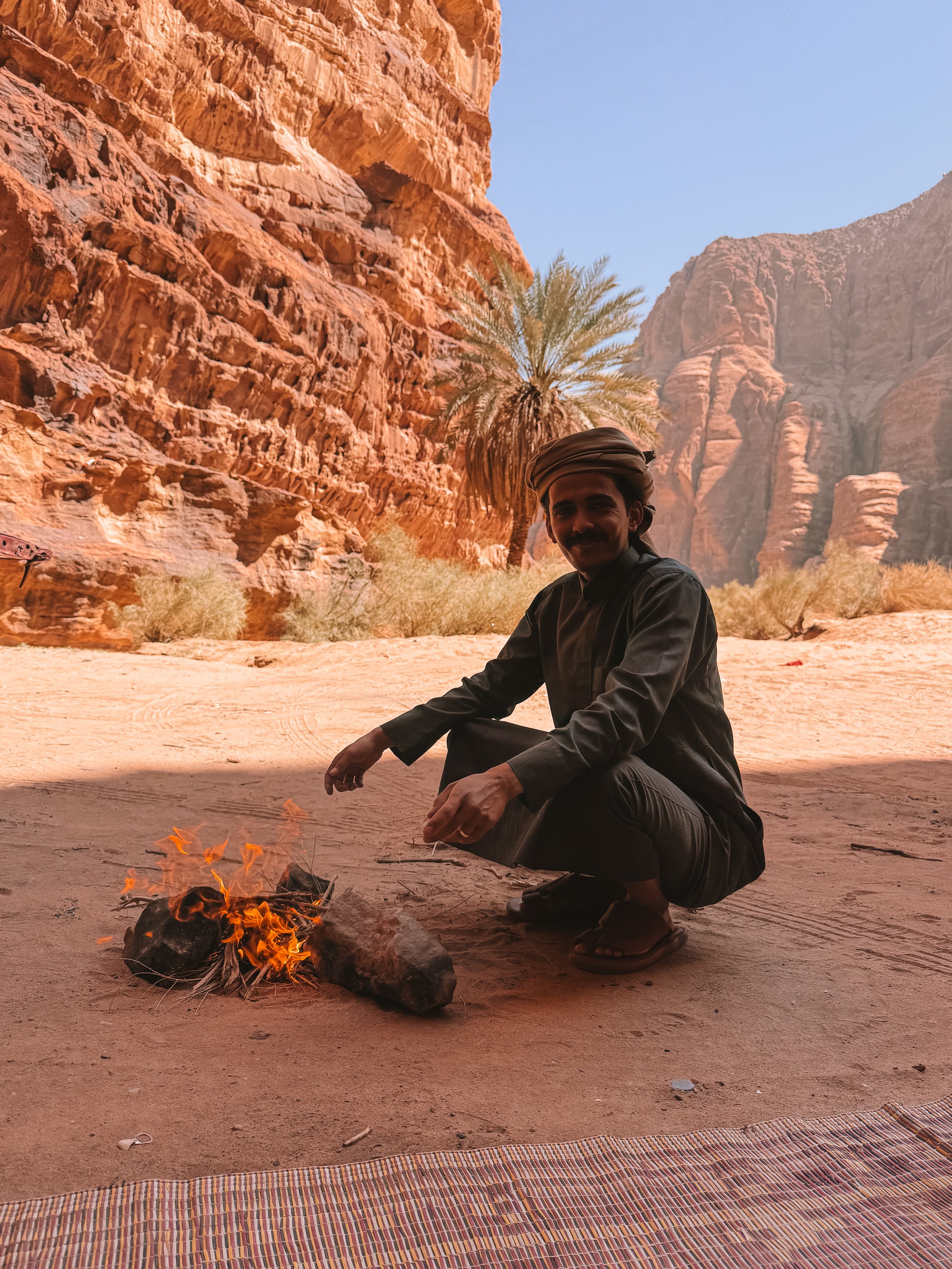
The scale of Wadi Rum resists easy processing: sandstone and granite rising 600 metres from the valley floor, the sand shifting from ochre to red to violet as the day moves. A private guide and a 4x4 are the right way to see it, taking in the Seven Pillars of Wisdom, Nabataean rock carvings at Lawrence's Spring, and the dune field at Umm Udhayhi. Stay for a Bedouin lunch built over an open fire on the desert floor, and don't rush the drive back.
-
Most visitors pay for one of the two paid viewpoints in the canyon. The better option is free: the Al-Khubtha Trail, a steep, uneven climb of 1–1.5 hours that ends directly above the Treasury, looking straight down into the courtyard with the mountains stretching away behind it. Time your main visit right, and you may also find the Treasury emptying out entirely at dusk, lit gold with almost no one else around.
-
At 430 metres below sea level, this is the lowest point on the surface of the earth, and the water carries a salt concentration nearly ten times that of a standard ocean. You don't swim, you float, involuntarily, fully supported by mineral density alone, looking up at a pale sky. It sounds like a novelty. It isn't. Book a proper resort for the day: shoreside showers matter more than you'd think once you're out of the water.
A seven-day route through the south of Jordan, where the country makes its strongest case: the coral reefs of Aqaba, the red desert of Wadi Rum, two full days in Petra, and the mineral waters of the Dead Sea.
A Jordanian Fieldweek: desert nights, ancient life & the Red Sea
A Jordanian Fieldweek: desert nights, ancient life & the Red Sea
A city carved, not built: Petra's Treasury
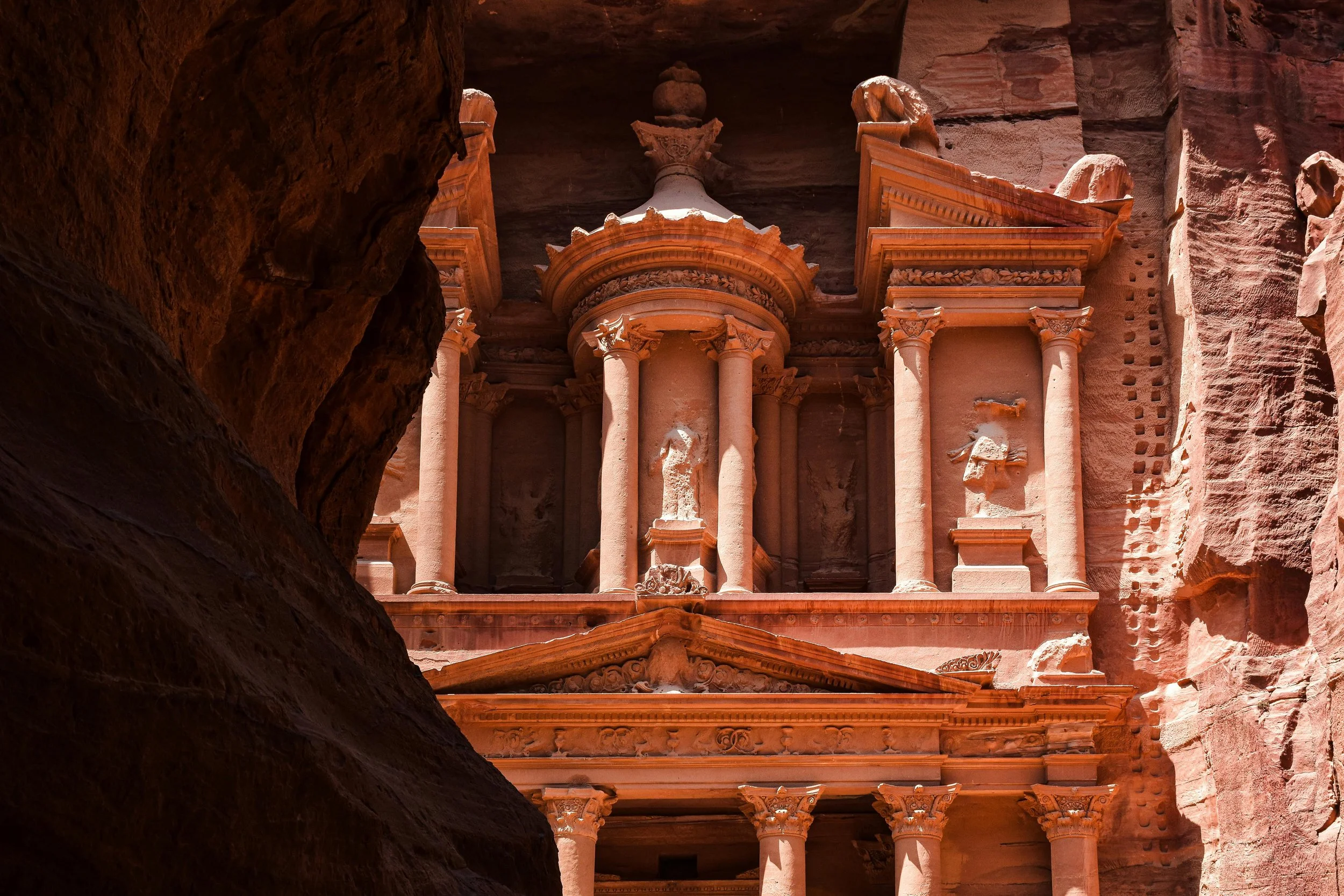
The Treasury does not announce itself. You reach it through the Siq, a 1.2km natural gorge with sandstone walls rising 80 metres overhead, banded in pink, orange, cream, and deep red by millions of years of geological pressure. Then the gorge narrows to a final crack in the rock, and the facade appears: 39 metres high, cut entirely from the living cliff face.
It was almost certainly built as a mausoleum for the Nabataean king Aretas III in the 1st century BC, its Hellenistic columns and broken pediment absorbed from centuries of Mediterranean trade and remade in a language the Nabataeans made entirely their own. What's more remarkable than the style is the method: the Treasury wasn't built up from the ground, it was carved down from the top of the cliff, stonemasons removing rock rather than placing it, in a process estimated to have taken three years. The city that grew around it once controlled the overland routes carrying frankincense, myrrh, and silk between Arabia and the Mediterranean, reaching a peak population of roughly 20,000, before sea trade routes made it obsolete and it slipped slowly into abandonment. It stayed that way until 1812, when the Swiss explorer Johann Ludwig Burckhardt arrived disguised as a pilgrim and brought Petra back to Western attention.
Petra was named one of the New 7 Wonders of the World in 2007, and it is, by a wide margin, the least visited of the seven, a fact explained entirely by its geopolitical context and nothing about the site itself. Having stood at five of the seven, we'd place Petra without hesitation among the most extraordinary. The others earn their reputation. Petra earns something closer to reverence.